I began 2019 with the unexpected expense of a new car. To help make up for my depleted bank account and offset the monthly car payments, I decided to accept a limited number of commissions. Along the way, some interesting barter proposals were made as well. I've enjoyed making these chains for people, though I still feel guilty accepting payment for them!
My first commission was for a necklace and bracelet set for my friend Elspeth. These are silver-plated copper, double-knit, six-loop chains. The necklace is 27" and the bracelet is 11".
My second commission was for a 10" silver-plated chain, to be worn suspended between the brooches of a Viking apron dress. This was one of the barter commissions--I got a set of handles from Elska for a Hedby bag in exchange, and I'm super excited to work on that project!
My third commission was a daunting one. Snorri wanted a 30" necklace, but the length wasn't the daunting part. He wanted this chain made of fine silver. I've never worked with fine silver before, though I have worked with Sterling. Fine silver, as you might imagine, is expensive, so I was paranoid about making a mistake the entire time I was weaving it! Fortunately, despite discovering that fine silver work-hardens REALLY fast, I completed the chain without errors. This was another barter commission--I received a dozen beautiful arrows from Snorri in exchange.
My fourth commission was for my friend Janna. She wanted a 16" silver-plated necklace. That was a nice, simple project. It was unique among these commissions in that I delivered in person, and got to see her put it on right away! There's nothing quite like the feeling of seeing someone wear and enjoy something you've made.
I posted process photos of all of these commissions on Facebook as part of my 365 Days of A&S Challenge, and it seemed like each post led to another commission request! Now on the docket, I have a silver-plated necklace for my friend Christi, and two Sterling silver bracelets for Atlantia's Royal Baker. I can get to work on Christi's right away, but I had to order the wire for the bracelets.
Showing posts with label Viking Wire Weave. Show all posts
Monday, March 11, 2019
Monday, May 21, 2018
Catch Up Post
As you may already know, my old laptop crashed last August. With it went all my research and documentation, and in many cases, my photos of projects in progress. As a result, nothing I worked on for a good eight months got documented here. This post is a quick-and-dirty attempt to correct that. The Evil Eye Quest has already received its own post, of course, but here is a smattering of what else I have been up to.
My love of heraldry began long before I discovered the SCA. We had a stained glass window in our house when I was a kid that was the Dillon coat of arms. Are we actually *that* Dillon family? I don't really know. But I have a fondness for the coat of arms nonetheless, and I know it is meaningful to my father. Therefore, for Christmas, I decided to make Dad a blackjack with the arms tooled and painted on.
This project also gave me the opportunity to try out vinegaroon, which I had taken a class on at Pennsic, to make the leather black instead of brown. A jug of vinegar, a bunch of steel wool, and two months later, a test piece of leather revealed that it did, in fact, make a delightful black shade.
I knew before I even started that that lion was going to put my artistic abilities to the test. As I did with the dragon on Fina's mug, I decided to only paint Dad's lion rather than tooling it. Somehow, foolishly, I thought that free-handing the lion would be a better idea than trying to trace it onto the mug.
It was SO bad that I posted a photo of the resulting critter on Facebook, asking my friends to guess what type of animal it was:
Unsurprisingly, nobody guessed it was a lion.
After that debacle, I resigned myself to tracing it. It was rough, but at least it was recognizable.
When I was done painting the device, I actually hesitated about applying the wax to the outside (even though I knew I had to). It had such a nice finish already--I didn't want to risk losing some of its very appealing sheen. Despite its pleasant appearance, though, I could feel that the vinegaroon process had already made the leather more brittle. I feared that leaving the exterior unprotected would lead to dry, cracked leather over time. And, of course, I had to seal up the seams to be able to pour the sealant inside.
Dad's got Envirotex Lite sealing the inside of his mug so he can drink his beloved hot tea from it.
The wax made the black a little bit darker, which was not entirely unexpected. It pushed the leather from the chocolatey black above to pretty much a true black. It created a nice, sharp contrast with the white of the coat of arms.
I used red cotton crochet thread to stitch Dad's mug--another first, and another experiment. It seemed like a strong, sturdy choice, and I knew that the waxing process would soak and protect the thread as well. I like the pop of color around the seams, complementing the red crescents and lion in the coat of arms.
Dad seemed very pleased with his present!
For Swap #13, I decided right away to go with the "Tokens" part of the title. I made 50 wire-wrap rings for Natasha to hand out as she sees fit. I chose an orange sea-glass bead for the rings because she had recently made for herself a beautiful orange and green gown.
After I finished the rings, though, it occurred to me that once she gave them all away, she would have nothing left for herself from this swap. So I decided to make her a little coin purse to match her new gown, and in which she could carry the rings at events.
This project was an absolute first for me. I don't sew. I've never made a purse. It's way out of period for where I normally work. Fortunately, Billy & Charlie's had JUST started offering kits to go with their new line of purse frames, and one of the options was a beautiful orange and green brocade. I snatched that up right quick and got to work! The kit came with a very detailed, step-by-step guide on how to create the purse. The whole thing from start to finish took me between two and three hours to complete.
I started by cutting the brown lining and the brocade to match the pattern they included (not pictured). With wrong sides out, I stitched the two pieces of fabric together, leaving a small gap at one side to turn later the purse rightside-out. I used saddle stitch, mostly because it's the one stitch I know from my leatherwork. After I turned the purse rightside-out, I had to YouTube a how-to video for closing the gap.
With that done, it was time to attach the purse frame. I tried hard to center the brocade motif in the frame, but it still came out a little bit crooked. I used a whipstitch to fasten the frame to the material.
After the frame was secure, I cut the holes and threaded the ribbon through the fabric before stitching the sides of the purse closed. I used brown thread, both to attach the frame and to stitch the sides of the purse closed. I again used whipstitch for the sides -- I think for future projects I will research and practice a better option, but it did get the job done.
The last step was to attach the two tiny tassels to the corners of the purse. And voila! It was done! It was a lot smaller than I anticipated, even knowing that I had ordered the small kit option. But I thought it was just too adorable, and I was also really proud of it!
It holds about a dozen of the rings at one time, without gaping open. I hope Natasha gets lots of use and enjoyment from it!
My friend Anna Leigh from Aethelmearc put out a call over the winter for artisans to contribute to the thank-you gift bags for the teachers at Gulf Wars. I volunteered to make some Viking Wire Weave chains, some wire-wrap rings, and also some Anglo-Saxon rings like this one in the British Museum.
I built up my stockpile of token rings as well, in anticipation of the approaching event season. Most of these will be left at A&S displays and given to performers at Keeper of the Central Flame, Wars of the Roses, and East Kingdom 50 Year. I'm still in the planning stages of tokens I can make for archers who do something spiffy--stay tuned for those!
There is one more top-secret largesse project that has been in the works for months, too, but I cannot reveal it yet--I'll link back to it here once it has been delivered!
Dad's Christmas Gift
My love of heraldry began long before I discovered the SCA. We had a stained glass window in our house when I was a kid that was the Dillon coat of arms. Are we actually *that* Dillon family? I don't really know. But I have a fondness for the coat of arms nonetheless, and I know it is meaningful to my father. Therefore, for Christmas, I decided to make Dad a blackjack with the arms tooled and painted on.
![]() |
| Before and after vinegaroon. |
I knew before I even started that that lion was going to put my artistic abilities to the test. As I did with the dragon on Fina's mug, I decided to only paint Dad's lion rather than tooling it. Somehow, foolishly, I thought that free-handing the lion would be a better idea than trying to trace it onto the mug.
It was SO bad that I posted a photo of the resulting critter on Facebook, asking my friends to guess what type of animal it was:
Unsurprisingly, nobody guessed it was a lion.
After that debacle, I resigned myself to tracing it. It was rough, but at least it was recognizable.
![]() |
| Finished painting, before wax. |
Dad's got Envirotex Lite sealing the inside of his mug so he can drink his beloved hot tea from it.
![]() |
| After wax. |
I used red cotton crochet thread to stitch Dad's mug--another first, and another experiment. It seemed like a strong, sturdy choice, and I knew that the waxing process would soak and protect the thread as well. I like the pop of color around the seams, complementing the red crescents and lion in the coat of arms.
Dad seemed very pleased with his present!
Nobelese Largesse Swap #13: Tokens, Talismans and Tools
For Swap #13, I decided right away to go with the "Tokens" part of the title. I made 50 wire-wrap rings for Natasha to hand out as she sees fit. I chose an orange sea-glass bead for the rings because she had recently made for herself a beautiful orange and green gown.
After I finished the rings, though, it occurred to me that once she gave them all away, she would have nothing left for herself from this swap. So I decided to make her a little coin purse to match her new gown, and in which she could carry the rings at events.
![]() |
| Gift received by Natasha! |
![]() |
| Supplies included in kit. |
I started by cutting the brown lining and the brocade to match the pattern they included (not pictured). With wrong sides out, I stitched the two pieces of fabric together, leaving a small gap at one side to turn later the purse rightside-out. I used saddle stitch, mostly because it's the one stitch I know from my leatherwork. After I turned the purse rightside-out, I had to YouTube a how-to video for closing the gap.
With that done, it was time to attach the purse frame. I tried hard to center the brocade motif in the frame, but it still came out a little bit crooked. I used a whipstitch to fasten the frame to the material.
After the frame was secure, I cut the holes and threaded the ribbon through the fabric before stitching the sides of the purse closed. I used brown thread, both to attach the frame and to stitch the sides of the purse closed. I again used whipstitch for the sides -- I think for future projects I will research and practice a better option, but it did get the job done.
The last step was to attach the two tiny tassels to the corners of the purse. And voila! It was done! It was a lot smaller than I anticipated, even knowing that I had ordered the small kit option. But I thought it was just too adorable, and I was also really proud of it!
![]() |
| Tiny purse! |
It holds about a dozen of the rings at one time, without gaping open. I hope Natasha gets lots of use and enjoyment from it!
Assorted Largesse Projects
My friend Anna Leigh from Aethelmearc put out a call over the winter for artisans to contribute to the thank-you gift bags for the teachers at Gulf Wars. I volunteered to make some Viking Wire Weave chains, some wire-wrap rings, and also some Anglo-Saxon rings like this one in the British Museum.
I built up my stockpile of token rings as well, in anticipation of the approaching event season. Most of these will be left at A&S displays and given to performers at Keeper of the Central Flame, Wars of the Roses, and East Kingdom 50 Year. I'm still in the planning stages of tokens I can make for archers who do something spiffy--stay tuned for those!
There is one more top-secret largesse project that has been in the works for months, too, but I cannot reveal it yet--I'll link back to it here once it has been delivered!
Tuesday, May 15, 2018
Laurel Quest: Sigrid
At Pennsic last year, there was one night early in War Week when the air quality was particularly atrocious. This, of course, brought on an attack of my chronic bronchitis. I was utterly miserable, and spent most of my last two days of war sleeping in a slouch chair. My good friend Aelfgar helped ease my suffering with assorted medications and gentle care, and I was very grateful for him.
Imagine my dismay, then, when I learned that upon returning home from Pennsic, he also fell ill. So did the other members of his household. So not only was I sick, but I was also Patient Zero.
Aelfgar's lady, Mistress Sigrid Briansdotter, turned this unfortunate turn of events into a fun learning opportunity. She issued me a challenge: create for her household a charm or talisman to protect them from the Evil Eye. In exchange, she said, I might ask a boon of her as well.
Well.
I had *heard* the term "Evil Eye" before, but that was literally all I knew about it. So I began to research. Many rabbit holes later, I settled on making not just one talisman, but a different one for each member of the household, inspired by their different personas.
I learned a LOT ... not just about the Evil Eye and folk cures, but also about the medieval understanding of anatomy and vision (and when you understand that, it's easy to see why they believed in things like the Evil Eye and gazing at idols). Additionally, I learned a lot about myself as an artisan--particularly that I need to practice WAY more discipline when it comes to completing projects in a timely manner. I think the boon I will ask of Sigrid will be forgiveness for the length of time she's had to wait!
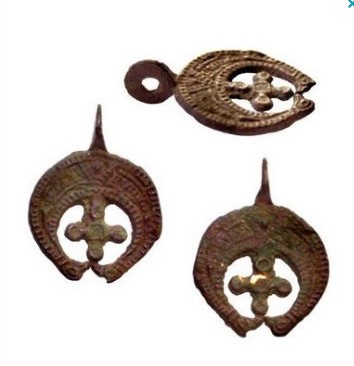
For Sigrid, I made a Viking Wire Weave chain with a lunula pendant, based on a pendant found at Birka.
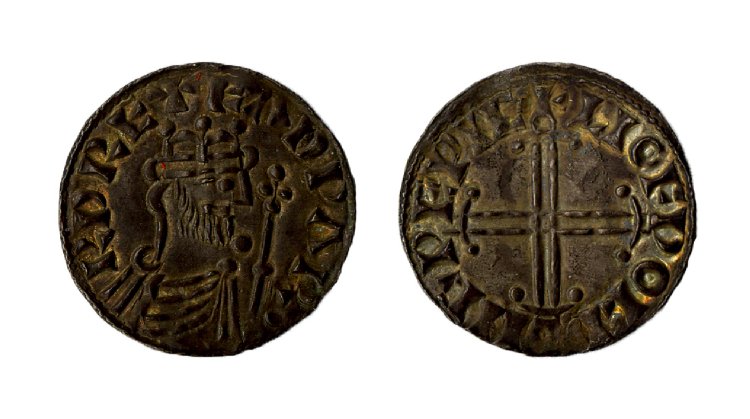
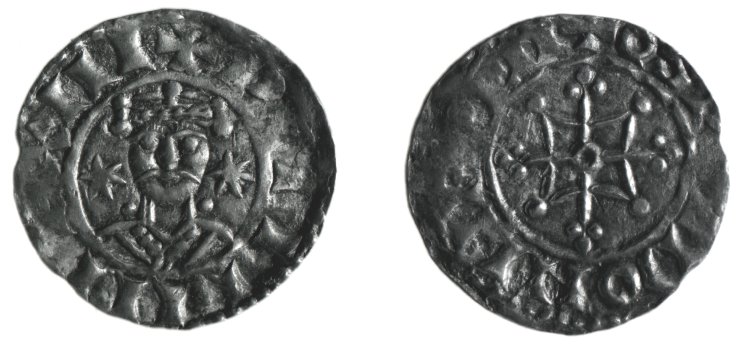
For Aelfgar, I made a leather flacket and bartered for three "silver" coins from three different English monarchs.
For Corun, I braided a six-strand, red, cotton cord.
Here's the documentation I sent along with the items I made:
Corun’s string is a six-strand braid of red cotton. It should be worn touching the skin and, according to some accounts, tucked out of sight beneath his clothing.
"Coin." British Museum. Accessed September 15, 2017. http://britishmuseum.org/research/collection_online/collection_object_details.aspx?objectId=1072750&partId=1&searchText=Edward the Confessor&images=true&page=1.
“Coin.” British Museum. Accessed September 15, 2017. http://britishmuseum.org/research/collection_online/collection_object_details.aspx?objectId=1086898&partId=1&searchText=William+the+Conqueror&images=true&page=1.
“Coin.” British Museum. Accessed September 15, 2017. http://britishmuseum.org/research/collection_online/collection_object_details.aspx?objectId=1089605&partId=1&searchText=coin+Harold&images=true&page=1.
Elworthy, Frederick Thomas. The Evil Eye: The Classic Account of an Ancient Superstition. Mineola, N.Y: Dover Publications, 2004.
Iona McCleery; A sense of the past: exploring sensory experience in the pre-modern world, Brain, Volume 132, Issue 4, 1 April 2009, Pages 1112-1117, https://doi.org/10.1093/brain/awp020
Maclagan, Robert Craig. Evil eye in the western Highlands. London: D. Nutt, 1902.
Oakseed, Trobere. "Leatherworking II." The Compleat Anachronist, no. 18 (March 1985): 38-42.
"Ornaments of Copper and Alloys, Part 2." Pycтpaнa. October 11, 2007. Accessed September 15, 2017. http://xn--80aa2bkafhg.xn--p1ai/article.php?nid=28038.
Robinson, Wayne. "Flackets - the Other Leather Bottle." The Reverend's Big Blog of Leather (blog), May 6, 2010. Accessed September 26, 2017. https://leatherworkingreverend.wordpress.com/2010/05/06/flackets-the-other-leather-bottle/.
Translation of Excerpts from
Embossed silver wide-brimmed lunnits covered with granules in the form of inscribed triangles and zigzags surrounding the convex hemispheres are known in the antiquities of Great Moravia (Dean U., 1976. P. 157). They were part of the jewelry of the nobility as a Great Moravian state, and Kievan Rus. Such pendant lunnitsa are well known for the treasures buried in the 10th-11th centuries. (Korzukhina GF, 1954. S. 88. Table VIII, 32, 34). Individual specimens are also found in rich burial burials of the 10th-11th centuries. around large cities (Table 54.3). In imitation of grain lunnits made cast bronze lunettes, completely reproducing the pattern of stamped-grained products (Table 54, 2). Such lunnits were found in the barrows of the 10th-early 12th century. almost all ancient Russian tribes, as well as in many cities.
For example, in Novgorod such a lunette is found in a layer below the 28th tier, dated according to the dendrochronology data of 953. A specimen decorated at the ends and sometimes in the middle by three circles is a peculiar species of broad-shouldered lunnits (Table 54, 1). These lunnitses also have prototypes in the Great-European antiquities (Dekap U., 1976. № 153-155), and in the East Slavic monuments they spread in the 10th-11th centuries. In Novgorod, an interesting find of such a lunette in the late-10th century layer was made. together with a necklace of finely-colored eye beads of yellow and black color (Sedova MV, 1981. Fig. 6, 6). Such beads date back to numerous analogies in Old Russian monuments X - the beginning of the XI century. The region of the largest distribution of wide-necked cast lunnits is the Leningrad, Kalinin, Smolensk and Bryansk regions. By the middle of the XII century. lunnitsy of this type are out of use.
Imagine my dismay, then, when I learned that upon returning home from Pennsic, he also fell ill. So did the other members of his household. So not only was I sick, but I was also Patient Zero.
Aelfgar's lady, Mistress Sigrid Briansdotter, turned this unfortunate turn of events into a fun learning opportunity. She issued me a challenge: create for her household a charm or talisman to protect them from the Evil Eye. In exchange, she said, I might ask a boon of her as well.
Well.
I had *heard* the term "Evil Eye" before, but that was literally all I knew about it. So I began to research. Many rabbit holes later, I settled on making not just one talisman, but a different one for each member of the household, inspired by their different personas.
I learned a LOT ... not just about the Evil Eye and folk cures, but also about the medieval understanding of anatomy and vision (and when you understand that, it's easy to see why they believed in things like the Evil Eye and gazing at idols). Additionally, I learned a lot about myself as an artisan--particularly that I need to practice WAY more discipline when it comes to completing projects in a timely manner. I think the boon I will ask of Sigrid will be forgiveness for the length of time she's had to wait!
For Sigrid, I made a Viking Wire Weave chain with a lunula pendant, based on a pendant found at Birka.
For Aelfgar, I made a leather flacket and bartered for three "silver" coins from three different English monarchs.
For Corun, I braided a six-strand, red, cotton cord.
Here's the documentation I sent along with the items I made:
Medieval Science and How it Relates to the Evil Eye
To understand the nearly-universal dread fascination with the power of the Evil Eye throughout medieval Europe, it helps to understand how academics of the time believed the senses operated. Medieval scholars had located the centers of sensory perception in the brain, but they believed the five senses were active entities that conveyed external stimuli to other, internal “senses”--common sense, imagination, judgement, memory, and fantasy. With regard specifically to vision, some theorized that a person’s eyes emitted rays towards a viewed object, while others believed objects emitted rays towards the eyes. In either circumstance, these rays could influence both the viewer and the object.
According to Augustine’s theory of vision, the life-fire within a person’ body--the same fire that animates and warms--is collected with unique intensity behind the eyes. For an object to be seen by a viewer, this fire must be projected in the form of a ray that is focused on the object, thereby establishing a two-way street along which the attention and energy of the viewer passes to touch its object. A representation of this object in turn returns to the eyes and is bonded to the soul and retained in the memory. This strong visual experience could be either negative (contamination by a dangerous or unsightly visual object) or positive (as in the miraculous power of an icon, when assiduously gazed upon, to heal one’s disease).
Popular beliefs and practices of the time support the conclusion that medieval people considered visual experience particularly powerful for one’s good or ill. It is easy to understand, then, why the belief in the Evil Eye persisted from classical times to the sixteenth century and beyond. It was thought of as a maleficent visual ray of potentially lethal strength. A person who had the Evil Eye could reportedly touch and poison the soul or body of an enemy.
Defenses against the Evil Eye were numerous and varied, as were cures for people already afflicted. Gestures, incantations, talismans and amulets, and even planting specific herbs and vegetables on one’s property were among the protections people practiced.
Examples of the Evil Eye Throughout the SCA Period
Belief in the power of the Evil Eye is documented even in the Bible itself. In the Book of Judges, camels are described as having “ornaments like the moon” hung around the neck for protection. Half moons have long been considered among the most potent of amulets against the Evil Eye.
Among the Greeks and Romans, statues of Nemesis were adored to save worshipers from fascination. The Romans also wore crescent moon pendants and even phallic adornments as protective amulets.
In 842 A.D., a monk of Monte Cassimo named Erchempert recorded, of a conversation with Landulf, Bishop of Capua, that the Bishop claimed whenever he met a monk’s eyes, something unlucky happened.
In England during the Black Death, it was widely believed that a glance from a sick person’s distorted eyes would communicate the infection to those on whom it fell.
In 1603, Martin Delrio, Jesuit of Louvain, published six books. In them, he writes that Maleficum existed, their powers derived of a pact with the devil, and that they infected others with evil by looking upon them with evil intent.
Persona-Inspired Remedies
Lunula (Sigrid)
Crescent-shaped Lunulae date back to Roman times, when they were worn by young girls as talismen of protecting against assorted ailments, including the Evil Eye. They have often been found in women’s graves from Birka to Russia, and are still worn in parts of the world today.
Because Sigrid is Swedish, the find from Birka caught my attention for this project. Lunula pendants were worn in particular by women of the era as talismans of fertility, female strength, and luck. It seems likely that this practice came via trade contact with the Slavic world. Pendants of this design have been found in Yugoslavia, Czechoslovakia, Poland, Hungary, Germany, Finland, Russia, and of course in Birka, Sweden. These granulated pendants were sometimes cast, while other times they were stamped. The were worn as a single pendant on a chain, or as one of many adornments on the festoons between turtle brooches.
The lunula pendant for Sigrid is a replica of a tenth century amulet, cast in bronze. It is suspended from a double-weave Viking knit chain woven of 28-gauge bronze wire.
Crescent-shaped Lunulae date back to Roman times, when they were worn by young girls as talismen of protecting against assorted ailments, including the Evil Eye. They have often been found in women’s graves from Birka to Russia, and are still worn in parts of the world today.
Because Sigrid is Swedish, the find from Birka caught my attention for this project. Lunula pendants were worn in particular by women of the era as talismans of fertility, female strength, and luck. It seems likely that this practice came via trade contact with the Slavic world. Pendants of this design have been found in Yugoslavia, Czechoslovakia, Poland, Hungary, Germany, Finland, Russia, and of course in Birka, Sweden. These granulated pendants were sometimes cast, while other times they were stamped. The were worn as a single pendant on a chain, or as one of many adornments on the festoons between turtle brooches.
The lunula pendant for Sigrid is a replica of a tenth century amulet, cast in bronze. It is suspended from a double-weave Viking knit chain woven of 28-gauge bronze wire.
Red String (Corun)
In the whole of the British Isles, the majority of Evil Eye protections and remedies seem to be of the “use what we have around the farm” variety. Onions and various bits of common animals were carried as talismans. The crescent-shaped pendants were also favored, undoubtedly a remnant of the Roman occupation. The most common remedy recorded, however, seems to have been the tying of a simple string around one’s neck. Accounts differ as to the specifics--color, ply, material, number of knots, and incantations spoken while tying the string all varied. The most frequently mentioned color is red, with green and multi-colored strings being favored as well. Where specific ply count is recorded, three-ply is what was used. The number three may have been significant to the protective and healing properties, as accounts often recorded either three knots tied in the string, or the string being wound three times around the neck of the afflicted.
These strings were commonly called sreang a chronachaidh, or snathahm cronachaidh (string or thread of hurting).
In the whole of the British Isles, the majority of Evil Eye protections and remedies seem to be of the “use what we have around the farm” variety. Onions and various bits of common animals were carried as talismans. The crescent-shaped pendants were also favored, undoubtedly a remnant of the Roman occupation. The most common remedy recorded, however, seems to have been the tying of a simple string around one’s neck. Accounts differ as to the specifics--color, ply, material, number of knots, and incantations spoken while tying the string all varied. The most frequently mentioned color is red, with green and multi-colored strings being favored as well. Where specific ply count is recorded, three-ply is what was used. The number three may have been significant to the protective and healing properties, as accounts often recorded either three knots tied in the string, or the string being wound three times around the neck of the afflicted.
These strings were commonly called sreang a chronachaidh, or snathahm cronachaidh (string or thread of hurting).
Corun’s string is a six-strand braid of red cotton. It should be worn touching the skin and, according to some accounts, tucked out of sight beneath his clothing.
Water and a Silver Coin (Aelfgar)
Also seemingly from the “use what we have around the farm” category comes a practice that appears to have been specific to Anglo-Saxon England: anointing the afflicted with fresh water that had been poured over a silver coin. Fresh water and a silver coin were frequent ingredients in other remedies of the time (a treatment for cataracts, for example, called for fresh water to be steeped with a silver coin and blades of grass). To cure an Evil Eye affliction, fresh water that has been poured over a silver coin should then be rubbed on the patient’s eyes.
Aelfgar’s hand-struck “silver” (they’re actually pewter) coins are from the reigns of Edward the Confessor (my own personal patron saint); Harold Godwinson, the last Saxon King of England; and William the Conqueror, the first Norman King of England.
Also seemingly from the “use what we have around the farm” category comes a practice that appears to have been specific to Anglo-Saxon England: anointing the afflicted with fresh water that had been poured over a silver coin. Fresh water and a silver coin were frequent ingredients in other remedies of the time (a treatment for cataracts, for example, called for fresh water to be steeped with a silver coin and blades of grass). To cure an Evil Eye affliction, fresh water that has been poured over a silver coin should then be rubbed on the patient’s eyes.
Aelfgar’s hand-struck “silver” (they’re actually pewter) coins are from the reigns of Edward the Confessor (my own personal patron saint); Harold Godwinson, the last Saxon King of England; and William the Conqueror, the first Norman King of England.
It seemed impractical to try and send fresh water--instead, I have provided a sturdy leather vessel in which Aelfgar may collect and store water at need. This flacket is sealed inside and out with beeswax and is safe for drinking water and other cool, non-alcoholic beverages from. The stopper will prevent splash-back as the flacket is carried, but it will leak if the flask is inverted. It is secured with a cotton fingerloop braid cord in Aelfgar’s heraldic colors. The carrying strap is hand-woven cotton, also heraldically-inspired. It’s Kumihimo, which wouldn’t have been known in England during Aelfgar’s time. None of the fingerloop braids I tried made a strap in a sufficient width for this purpose, so I improvised (or cheated…) a little.
Works Cited
"Coin." British Museum. Accessed September 15, 2017. http://britishmuseum.org/research/collection_online/collection_object_details.aspx?objectId=1072750&partId=1&searchText=Edward the Confessor&images=true&page=1.
“Coin.” British Museum. Accessed September 15, 2017. http://britishmuseum.org/research/collection_online/collection_object_details.aspx?objectId=1086898&partId=1&searchText=William+the+Conqueror&images=true&page=1.
“Coin.” British Museum. Accessed September 15, 2017. http://britishmuseum.org/research/collection_online/collection_object_details.aspx?objectId=1089605&partId=1&searchText=coin+Harold&images=true&page=1.
Elworthy, Frederick Thomas. The Evil Eye: The Classic Account of an Ancient Superstition. Mineola, N.Y: Dover Publications, 2004.
Iona McCleery; A sense of the past: exploring sensory experience in the pre-modern world, Brain, Volume 132, Issue 4, 1 April 2009, Pages 1112-1117, https://doi.org/10.1093/brain/awp020
Maclagan, Robert Craig. Evil eye in the western Highlands. London: D. Nutt, 1902.
Oakseed, Trobere. "Leatherworking II." The Compleat Anachronist, no. 18 (March 1985): 38-42.
"Ornaments of Copper and Alloys, Part 2." Pycтpaнa. October 11, 2007. Accessed September 15, 2017. http://xn--80aa2bkafhg.xn--p1ai/article.php?nid=28038.
Robinson, Wayne. "Flackets - the Other Leather Bottle." The Reverend's Big Blog of Leather (blog), May 6, 2010. Accessed September 26, 2017. https://leatherworkingreverend.wordpress.com/2010/05/06/flackets-the-other-leather-bottle/.
Translation of Excerpts from
“Ornaments of Copper and Alloys, Part 2”
Привески играли роль не просто украшений, но в значительной степени амулетов-оберегов, они должны были охранять их обладателей от злых духов. К оберегам относят такие типы привесок, как зооморфные, миниатюрные предметы быта и орудия, лунницы и др. Наиболее распространенной и древней формой привесок была круглая, олицетворяющая солнце.The pendants played the role of not just decorations, but largely amulets-charms, they had to protect their owners from evil spirits. The amulets include such types of pendants as zoomorphic, miniature objects of life and tools, lunettes, etc. The most widespread and ancient form of pendants was a round, personifying the sun.
Лунницы - привески в виде полумесяца, символизирующие луну, - типичное и наиболее распространенное общеславянское украшение. Находки их известны в Югославии, Чехословакии, Польше, Венгрии, Германии, Финляндии, Швеции (Арциховский А.В., 1946. С. 88). Б.А. Рыбаков писал: «Если руководствоваться мифологией, то их (лунницы) следует считать принадлежностью девичьего убора, так как Селена - богиня Луны - была покровительницей девушек» (Рыбаков Б.А., 1971. С. 17). На Руси лунницы получили широкое распространение уже в X в. и просуществовали вплоть до середины XIV в. Специальное исследование этим украшениям посвятила В.В. Гольмстен, разработавшая их типологию и хронологию, основываясь на материалах собрания исторического музея (Гольмстен В.В., 1914. С. 90).
Lunnitsa - pendants in the form of a crescent moon, symbolizing the moon - a typical and most common Slavic adornment. Their finds are known in Yugoslavia, Czechoslovakia, Poland, Hungary, Germany, Finland, Sweden (Artsikhovsky AV, 1946. S. 88). BA Rybakov wrote: "If you follow the mythology, then their (lunnitsa) should be considered a part of the maiden's dress, since Selena - the goddess of the moon - was the patroness of the girls" (Rybakov BA, 1971. S. 17). In Russia, lunettes became widespread in the X century. and existed until the middle of the XIV century. A special study devoted to these ornaments was made by V.V. Holmsten, who developed their typology and chronology, based on the materials of the collection of the historical museum (Holmsten VV, 1914. P. 90).
Тисненые серебряные широкорогие лунницы, покрытые зернью в виде вписанных треугольников и зигзагов, окружающих выпуклые полушария, известны в древностях Великой Моравии (Декан У., 1976. С. 157). Они входили в состав украшений знати как великоморавской державы, так и Киевской Руси. Подобные привески-лунницы хорошо известны по кладам, зарытым в Х-ХI вв. (Корзухина Г.Ф., 1954. С. 88. Табл. VIII, 32, 34). Отдельные экземпляры встречаются и в богатых курганных погребениях Х-ХI вв. около крупных городов (табл. 54,3). В подражание зерненым лунницам изготовляли литые бронзовые лунницы, полностью воспроизводящие узор штампованно-зерненых изделий (табл. 54, 2). Такие лунницы встречены в курганах Х-ХI - начала ХII в. почти всех древнерусских племен, а также во многих городах.
Например, в Новгороде такая лунница найдена в слое ниже 28-го яруса, датирующегося по данным дендрохронологии 953 г. Своеобразной разновидностью широкорогих лунниц являются образцы, украшенные по концам, а иногда и в середине тремя кружочками (табл. 54, 1). Эти лунницы также имеют прототипы в великомо-равских древностях (Декап У., 1976. № 153-155), а в восточнославянских памятниках получают распространение в Х-ХI вв. В Новгороде сделана интересная находка такой лунницы в слое конца X в. вместе с ожерельем из ластовых глазчатых бусин желтого и черного цвета (Седова М.В., 1981. Рис. 6, 6). Подобные бусы датируются по многочисленным аналогиям в древнерусских памятниках X - началом XI в. Район наибольшего распространения широкорогих литых лунниц - Ленинградская, Калининская, Смоленская, Брянская области. К середине XII в. лунницы этого типа выходят из употребления.
Уже в XI в. появляется новый тип лунниц - узкогорлые, или круторогие (табл. 54, 6-8). Орнаментация их разнообразна: это и точечный подражающий зерни орнамент по контуру привески (табл. 54, 6), и глазковый орнамент (табл. 54, 8), и соединение того и другого (табл. 54, 7), и треугольники ложной зерни (табл. 54, 9). Круторогие лунницы распространены были на всей территории северной и южной Руси. Время их наибольшего распространения - ХI-ХII вв. Именно тогда создавались и такие своеобразные формы, как узкорогие язычковые (табл. 54,10) лунницы и лунницы, подражающие славянским, но изготовленные в финской среде методом литья по восковой модели (табл. 54,11).Already in the XI century. there is a new type of lunnits - narrow-necked, or steep-necked (Table 54, 6-8). Their ornamentation is diverse: it is a dot pattern imitating the grain along the contour of the pendant (Table 54, 6), and eye ornamentation (Tables 54, 8), and the combination of both (Table 54, 7), and triangles of false grain Table 54, 9). Twisting lunnits were common throughout the northern and southern Russia. The time of their greatest distribution - XI-XII centuries. It was then that such peculiar forms were created as well, such as the narrow-horned tabernacle (Table 54, 10), lunnits and lunnits imitating the Slavic, but made in the Finnish environment by casting using the wax model (Table 54, 11).
Extant Examples
Silver Coin: Edward the Confessor. British Museum.
Silver Coin: Harold II. British Museum.
Silver Coin: William the Conqueror. British Museum.
10th c. Lunula pendant.
Monday, March 6, 2017
Atlantia KASF 2017
In years past, I have displayed at Atlantia's KASF as part of a group--the first time with my household, and the second time with the Barony of Lochmere. This year, I displayed by myself, as the A&S Champion for the Barony of Concordia of the Snows. Because I'm a champion of the East and not Atlantia, I did not participate in the Inter-Baronial Champions' Competition. Rather, I entered the open display. I received some delightful feedback about my work, particularly from the Baron of Nottinghill Coill (who was also astounded when he learned I had traveled from upstate NY to attend the event!).
Documentation text:
Comparing Copper and Silver as Used in Viking Wire Weave
A few years ago at Pennsic, an old friend sat down with me beneath our baronial pavilion and taught me to make Viking Wire Weave chains (sometimes also called Viking Knit or Trichinopoly). I took to it almost immediately, and began entering pieces in A&S competitions and displays shortly thereafter.
In one such competition at the Feast
for St. Brigit in the Barony of Lochmere, I entered two necklaces.
These were woven of what had become my go-to material: 26-gauge, dead
soft, enameled copper wire. I like that it was inexpensive but still
easy to work with – less prone to kinks and tangles than cheaper
options at my local Michael's. I also like the array of color options
available, because I could achieve a period look (most extant
examples are woven of silver wire) or a less-period, heraldic chain,
as desired.
Copper was a solid and reasonable
substitute for silver, with valid reasons for its selection. On a
molecular level, copper is very similar to silver and behaves in much
the same way when worked. Additionally, as stated above, it was
available in a silver-colored enamel. And, of course, it was far less
expensive than actual silver wire.
In her judge's feedback that day,
Mistress Mary Isabel of Heatherstone suggested I try working in real
silver, even if only once, so that I could gain a deeper
understanding of how it differs from copper by actually feeling it as
I work, rather than just reading about the differences.
It has taken me two years to work up
the courage, make the investment, and take that plunge. I have to
admit that I was skeptical before I started. How different could it
actually be, anyway? By this point, I had worked with copper in
gauges ranging from 20 to 28 and in tempers from dead soft to half
hard. I expected this experiment to demonstrate only which temper
produced a similar feel, and perhaps to reveal a slight difference in
the silver color of the chains.
Boy, was I in for a surprise.
For the purposes of this experiment, I
selected 28-gauge, dead soft wire in enameled copper and sterling
silver. I used the same mandrel, and wove identical chains of
six-loop, double-weave knit. I began with the copper chain.
From the moment I began to weave with
the silver, I could feel a difference. Though it was the same gauge
as the copper, it felt more substantial in my fingers. More stable,
perhaps. It was certainly less prone to kinking as I worked with it.
It was somehow smoother, too. It made me think of satin. I was
somewhat confounded as I continued to work. How could something be
sturdier and softer, at the same time?
Unlike with the enameled copper, I
didn't have to worry about friction with the silver as I wove. With
the copper, there's a risk that the scraping will damage the enamel
finish, causing the color to flake off.
Containing the loose ends of each
piece of wire seemed easier with the silver as well. In running my
hands along the woven chain, there are noticeably fewer “poky bits”
protruding from the silver than from the copper (You are welcome to
try that on these pieces, but please slide your fingers lightly and
slowly! I wouldn't want you to injure yourself).
For this display, I left the chains
incomplete (when finished, they will be necklaces). I drew them
through a wooden drawplate for about half of their length, so that I
would have examples of the chains both drawn and undrawn.
The finished pieces are all enameled
copper, displayed to show the variety of weaves and designs possible
with Viking Wire Weave.
I look forward to working more in
silver (as finances allow) in the future – it was a true pleasure
to work with!
Wednesday, January 11, 2017
Nobelese Largesse Swap 11: Kingdom/Household Pride
The theme for Nobelese Largesse Swap #11 is Kingdom/Household Pride. It's actually a theme I suggested--I figured we could all learn a little about someone else's kingdom while we were at it! My recipient is Lady Izza bint Amat al-Rahman, who lives in the Shire of Arenal in Meridies.
Meridies is crazy. That was my first impression, anyway, as I began browsing around the kingdom website. Did you know they have FOUR populace badges?! Four! So, I had to find out a bit more about these badges if I intended to incorporate them into my project.
Other items I considered incorporating into my project were Meridies' kingdom arms, the arms of the Shire of Arenal, and Izza's own arms. Putting all of these things onto a single item would be WAY too busy, so I decided to pare it down to the Kingdom badge (but ...which one?!) and a single set of the wings from Arenal's arms. I planned to do a limp-bound book (hooray for new skills!), with the kingdom badge on the front and the wings on the back.
I tried to find out about the Meridies badges on my own. Google didn't reveal anything, though. Then I tried asking in various groups on Facebook, still to no avail. Finally, I had to ask my recipient (via the swap coordiantors) which badge she preferred to use, since as best as I could figure they're all interchangeable.
The answer came back: Izza prefers the third option above. Great! The leather I had chosen for the project was white already, so it should be easy to tool and paint the black bar and the three stars on the front, and the blue wings on the back.
I've only ever done plain books before, so I wasn't sure exactly how to place the designs to be centered on the covers. I figured, though, that I could just bind up the book and *then* tool the decorations, because I could open it to lay the covers flat on the marble slat for tooling.
The binding went well: I did five folios of ten pages each, for a hundred-page book (5 folios x 10 sheets = 50, front-and-back = 100 pages). After folding the flap over and securing it with a white leather cord (photo, right), I worried that the Meridies badge would look really squished in the visible front cover space. But then I realized that the flap itself could be one third of the badge design! This made me really happy.
That happiness was short-lived.
I don't know if it was the dying process or the tanning process (or both) for this particular leather, but it did not take to tooling AT ALL. And then the paint wouldn't adhere to the surface, either. And in the process of fighting with it, several of the pages got stained. All in all, it was a catastrophic failure--completely unsalvageable.
I was not at all eager to jump into anything else even remotely experimental at this point--the deadline loomed, the holidays were upon me, AND we were in the late stages of buying our first house. So I opted for a tried-and-true item: a Viking chain necklace. They are from the correct time period for Izza's persona, and I was 100% confident I would not experience any project failures--catastrophic or otherwise!
Actually, I made two necklaces. Both necklaces are woven from 26 gauge enameled copper wire (I sure do love that wire!), with five starting petals. I used a trusty Sharpie marker as my mandrel.
The first one I made was not entirely period--it's my own created design of single-weave in one color over double-weave of another color. In this case, it was single black and double silver -- Meridies colors. The inner core and outer layer are woven concurrently and drawn together.
Then, because this is not technically a period design, I also made a standard Viking double-weave chain in just silver.
They went in the mail today, and should be delivered on Friday. I hope Izza likes them!
I tried to find out about the Meridies badges on my own. Google didn't reveal anything, though. Then I tried asking in various groups on Facebook, still to no avail. Finally, I had to ask my recipient (via the swap coordiantors) which badge she preferred to use, since as best as I could figure they're all interchangeable.
The answer came back: Izza prefers the third option above. Great! The leather I had chosen for the project was white already, so it should be easy to tool and paint the black bar and the three stars on the front, and the blue wings on the back.
I've only ever done plain books before, so I wasn't sure exactly how to place the designs to be centered on the covers. I figured, though, that I could just bind up the book and *then* tool the decorations, because I could open it to lay the covers flat on the marble slat for tooling.
The binding went well: I did five folios of ten pages each, for a hundred-page book (5 folios x 10 sheets = 50, front-and-back = 100 pages). After folding the flap over and securing it with a white leather cord (photo, right), I worried that the Meridies badge would look really squished in the visible front cover space. But then I realized that the flap itself could be one third of the badge design! This made me really happy.
That happiness was short-lived.
I don't know if it was the dying process or the tanning process (or both) for this particular leather, but it did not take to tooling AT ALL. And then the paint wouldn't adhere to the surface, either. And in the process of fighting with it, several of the pages got stained. All in all, it was a catastrophic failure--completely unsalvageable.
I was not at all eager to jump into anything else even remotely experimental at this point--the deadline loomed, the holidays were upon me, AND we were in the late stages of buying our first house. So I opted for a tried-and-true item: a Viking chain necklace. They are from the correct time period for Izza's persona, and I was 100% confident I would not experience any project failures--catastrophic or otherwise!
Actually, I made two necklaces. Both necklaces are woven from 26 gauge enameled copper wire (I sure do love that wire!), with five starting petals. I used a trusty Sharpie marker as my mandrel.
The first one I made was not entirely period--it's my own created design of single-weave in one color over double-weave of another color. In this case, it was single black and double silver -- Meridies colors. The inner core and outer layer are woven concurrently and drawn together.
![]() |
| Single black over double silver in progress. |
![]() |
| Silver double-weave, before drawing. |
They went in the mail today, and should be delivered on Friday. I hope Izza likes them!
Subscribe to:
Posts (Atom)